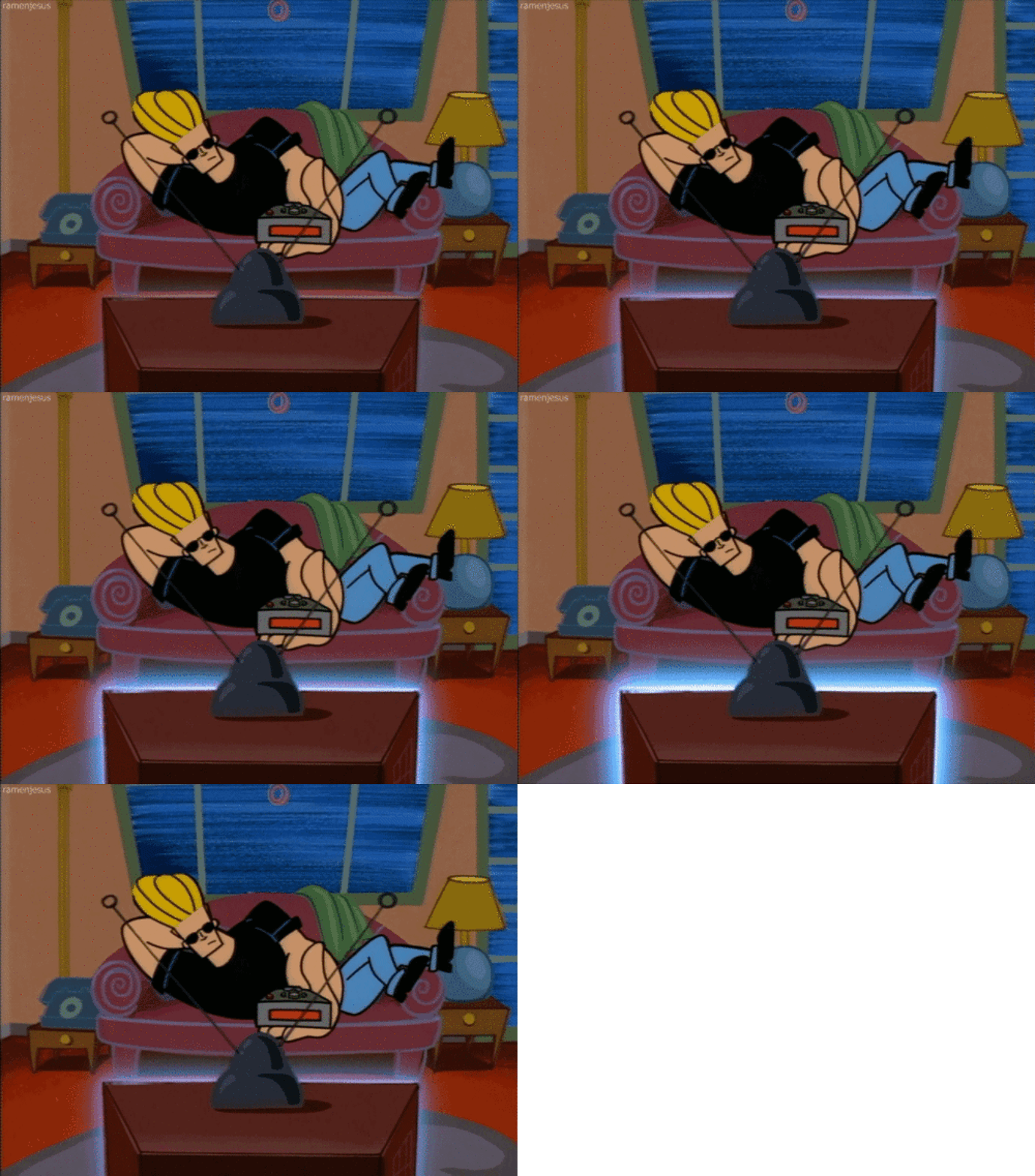
This is Emo

Reading Summary

Klosterman discusses the negative impact of media on society’s romantic perception of love. He begins with an anecdote to illustrate the point that people’s desires for love and a partner are driven by what is portrayed through the media. This can happen through actors in movies, musicians in songs, or plot lines in television and cinema. There has been an erosion of “normal” love and “fake” love has become the new norm, where people fall for and desire elements that don’t truly represent what love should be for. The media also disrupts what is perceived to be desired by creating unlikely romances that cannot be duplicated in the real world. This happens through best friends falling in romantic love or the attractive woman falling for the nerdy but sweet guy, but ultimately these loves are fake and unsustainable. Occasionally, the media does an accurate job in presenting a true, realistic love story, however these are so rare and hardly materialize in the real world that the hope and faith that should be restored are eroded more. All in all, this creates a desire for fake love by those in society, which destroys faith in real love, and simply creates a society that does not believe in love because they do not see it beyond the media’s presentation.

Outside Example

What immediately comes to mind for me is the variety of love reality/competition shows such as The Bachelor/Bachelorette, Love Is Blind, and Love Island. I have watched very little of all of these shows, with the exception of Love Is Blind, which I thoroughly enjoyed. The main reason was because of its unique structure and interesting characters, as well as the portrayal of not being a fixed and overly saturated drama. Each show though, generates their own unique responses to love, relationships, their desirability, feasibilities, and the media’s presentation of it. 

Reading Connection

Love Is Blind is particularly unique and desirable by many that are not overly interested in love competition shows. It does not contain the disingenuous, overly scripted, and unrealistic love environment that other shows do. “Players” must first find love through an emotional connection and only spend a short bit of time on an extremely romantic and fantasy honeymoon before being thrown back into the real world. This part and the issues that develop before players are forced to answer the question of marriage reveals if true love can exist. While other shows keep players in an unsustainable environment to find love, this show tests players true loves. Additionally, players in other shows have incentives to stay on for as long as possible for the sake of becoming famous or “winning” the show. 

This further perpetuates the image of “fake” and undesirable love that is given to audience viewers. Ultimately when this falters, fans do eventually lose hope in true love or believe these incredible circumstances are unlikely to happen to them. With Love Is Blind, the show is based on finding true, genuine love without an physical attachments. Furthermore, players go through the whole process simply by saying yes in the beginning and have no incentive to fake loving someone to continue playing the game. Players are in everyday, real-world problems and only accept marriage if both parties are truly in love. Overall, this should give hope to real love being possible and goes against the mainstream media presentation of love in competition shows and presents many real ways in which viewers can find love of their own.

This Is Emo

Reading Summary

This chapter of Sex, Drugs and Cocoa Puffs by Chuck Klosterman talks about the unattainable love seen in media. This fake love has created a standard in society which has made each individual expect more from their significant other in order to meet the demands established by a character in a certain movie or television show. Movies have also created many scenarios of impossible love happen making individuals believe that what they are seeing can happen to them. The book uses the movie When Harry Met Sally as an example of one unique scenario. The movie’s message was the plausibility that your best friend could become your soul mate. This plus the common theme “everything will work out somehow” seen in movies create an even more unrealistic expectation. Television and movies are not real life.

Outside Example

This chapter reminded me of the movie The Proposal starring Ryan Reynolds and Sandra Bullock. The movie is about Margaret (Sandra Bullock) convincing her assistant Andrew (Ryan Reynolds) to pretend they are a couple that will get married soon so Margaret isn’t deported to Canada. Despite many legal consequences it may have, Andrew agrees but only if Margaret gives him a promotion in the company. The major problem is that they make up a story that they will visit Andrew’s family and get married there. It comes as a surprise to all his family because they hadn’t heard of Andrew having a significant other. Although many problems arise in the movie, in the end Andrew and Margaret end up falling in love.

File:THE PROPOSAL.jpg - Wikimedia Commons

Reading Connection

This chapter reminded me of The Proposal because in the movie we see a very complicated situation where an editor has to act that she will marry her assistant in order to keep her job. Similar to the example the chapter used, this movie creates a very unlikely story but many individuals can relate to it because most of the population works and might hate a coworker/manager similar to the movie. Thus individuals can place themselves in these kinds of what ifs and believe these things are actually possible (similar to your best friend can become your soulmate). In this example, the movie, similar to the chapter shows the theme of “it will work out in the end somehow.” In the movie, Andrew’s family finds out and the deportation officer after Margaret ends up busting them. Seeming like Margaret was going to lose her job and get deported, Andrew finds her and tells her how he really feels and proposes to her, she ends up keeping her job and both end up happy. This is something very unrealistic and sends a message to society of no matter how hard a situation can be, it will be fine in the end.

Monday – Klosterman’s “This Is Emo”

READING SUMMARY

Klosterman explains the belief that all people, including him, will never be truly satisfied by love. All of us, as Americans, have the “inability to experience the kind of mind-blowing, transcendent romantic relationship” that we think is a normal part of life (Klosterman 2). There will never be a right-place-right-time type of romance, as it will always be compared to the fake love shown by the media. Movies and songs tell us how love is supposed to feel, and we constantly chase this feeling, wanting to feel that real love as well. Klosterman blames this fake love on mass media, as it has made it impossible to have normal love. We are all acting out this fake love, and even take on the characters of romance that the media has given us, and we’re all susceptible to falling for such characters and acting. We think we’re going to find our soulmate out of nowhere, but life isn’t like the movies that we grew up watching. This is especially noticeable in the common plot of romance movies where someone falls in love with their best friend, and this “dooms us to disappointment” (6). Mass media consistently leads us in the wrong direction romantically, making us “need something deeper than what we want” (6). Such famous romance movies have made it normal to think that your best friend is your soulmate. What we want is this fake love where everything works out and you find your soulmate and live happily ever after, not real love; therefore, we’ll never be satisfied.

OUTSIDE EXAMPLE

One of my favorite songs is Turning Out by AJR, and I’ve always really connected to it. It’s about being confused with love and not knowing what it should really feel like. It’s the feeling of not knowing if you’re simply not in love at all or if it’s just not like everything you thought it’d be, and not being able to tell the difference. You have to learn the hard way that love isn’t like it is on television, or like most songs, and I think that this is one of the few songs that accurately depicts this unknown feeling of what love should really feel like. Real love not what we expect, and then we question it, unsatisfied and confused, just like Klosterman discusses in the reading.

READING CONNECTION

Turning Out by AJR puts Klosterman’s reading into more relatable words. Turning Out is about love not being like the stories we grew up on, and feeling confused and lost due to that; Klosterman explains this feeling. The song lyrics “Maybe I’m stuck on what I see on TV / I grew up on Disney / But this don’t feel like Disney” really shows this feeling. Klosterman blames television and the media for leading us to desperately want fake love and telling us what it should feel like, and then we are stuck being confused about why our love life doesn’t feel right. Many of us grew up on Disney and rom-coms, thinking that they would be us someday, and being disappointed when Prince Charming didn’t show up out of nowhere, when we didn’t feel love like that. The song goes on to say “In my mind / I thought the birds would sing and sparks would fly / But it’s just quiet / Am I cruel? / Or am I ignorant or was I fooled / By the stories I knew?” When love doesn’t feel like we think it should, we’re left wondering what’s wrong with it. Klosterman gives us the answer: it’s mass media; it really is that you were “fooled / By the stories [you] knew.” We grow up thinking that we’ll always get asked to the dance when no one else is there for us, that we’ll marry our best friend, that we’ll live happily ever after with our soulmate, like in the movies. Both Turning Out and Klosterman’s reading reveal the sad truth, that real love will never be like the movies, and we’ll always be left unsatisfied and disappointed.

“Postmodern World”

Summary: The article starts by discussing the postmodern world and the role of belief systems, more importantly the suspicion of belief systems and how it divides society. We have a more realistic view of reality, but we have less understanding of truth and this is difficult because while we don’t know how to live in multiple constructed realities, we also don’t know how to live in this era. It talks about the different perspectives of trying to reconstruct reality from the traditional viewpoint to beliefs about feminism. Next it shows how politics are theatrical in a sense of being a social construction and how this construction is a business. It then talks about the three ways that are shaping this transition; the breakdown of old ways of belief, emergence of a new polarization, and birth of global culture. The breakdown of old beliefs stems from the freedom to create new realities that get spread by mass media and plays out like stage management, where the truth of the plot is what is questioned. When discussing polarization, it gives examples of political viewpoints with several others to show that it is not about different beliefs but different kinds of beliefs. Global memes make up the new very diverse global culture that is developing, a way or reversing evolution to bring back a common culture. Next it talks about the threats of ordinary and authority blocking threats to the belief systems. It ends the article claiming that the postmodern society needs to look at history to fully develop.

Outside Example: When reading this article, I thought about the show Waco. It shows what happened in Waco with the cult. The show gives insight into the negotiation process as well as the events that occurred in light of them staying put. The show gives a good balance of being objective and trying to show both sides and gives a little information about their belief system through his speech and the information gathered by the undercover.

Reading Connection: The article talks about how we are more accepting of new belief systems and this made me think of Gary the negotiator. In the show he tries to reason with the other agents and acknowledges their beliefs and works with them and not against them. Cults in general can show the breakdown of old belief systems and the polarization with them. The show also highlights how mass media and their reporting played a role in spreading the belief system and how it caused problems in political sense with the protesters scene.

From the Green Berets to America’s Army

Reading Summary

The article first introduces the video games “Special Force” by Hezbollah and “America’s Army” designed by the U.S. Army. The purpose of both of these first-person shooter games is to attract new recruits. Both organizations claim that their video games are educational entertainment. It then goes in to explain what propaganda is and how it is closely related to ideology. The article then goes to talk about what immersion is and the ideas of identification, interaction, and intense engagement. All 4 of these are characteristics of the central gaming experience.

Outside Example

When talking about the 4 characteristics of the central gaming experience, I first thought of the VR game Beat Saber. I don’t own it, but one of my friends has a VR headset and such and let me play it a while back. The goal is to hit boxes with 2 different lightsabers that are coming at you in such a way that they line up with the beat. You can pick a bunch of different popular songs to do it to and it’s super satisfying to watch people do in on instagram or youtube, too.

Reading Connection

Regarding the 4 characteristics, the game seems to hit every one of those. It is immersive in the way that it physically tricks your brain into thinking you’re there. It is intensely engaging because it provokes “states of intense concentration” due to the general difficulty of the game. The identification part is kinda weird because you don’t have to identify with the character because you are the character, but in that way, you could intensify yourself as the character in the game. And finally, it is obviously interactive, as most VR games are.

Agenda 4-24

“From the Green Berets to America’s Army: Video games as a vehicle for political propaganda,” an excerpt from J.P Williams and J. H. Smith (2007) The Player’s Realm: Studies on the Culture of Video Games and Gaming. Jefferson, NC: McFarland and Company.

Join Zoom Meeting
https://zoom.us/j/2622686644?pwd=OFR0L2xaNEtnbUd0UUZZUW8waU5yQT09

Meeting ID: 262 268 6644
Password: 104413

Activity

What is a piece of political propaganda you have seen recently?

Example: Las Vegas mayor wants to be “control” group

Agenda 4-22

Juul, J. (2011). “Fiction.” Excerpt from Half-real: Video games between real rules and fictional worlds., 42 pages.

Jacob Sanchez is inviting you to a scheduled Zoom meeting.

Topic: Jacob Sanchez’s Personal Meeting Room

Join Zoom Meeting
https://zoom.us/j/2622686644?pwd=OFR0L2xaNEtnbUd0UUZZUW8waU5yQT09

Meeting ID: 262 268 6644
Password: 104413

Activity

In your groups answer either question 1 or 2, share your answers with each other

Q1: Are there any connections between the games you are playing and the pandemic? Q2: If you are not playing any games, how is the fiction you are consuming related to the pandemic?

Chapter 8 Homie

In chapter 8 of Smith’s book, he talks about mediums. New types of mediums are categorized by their level of interactivity. Interactivity is how well you can interact or connect with things within the media. In some ways, past mediums we use to consume content is not interactive, such as TVs or radio. However, Smith still argues that we are never really completely passive while consuming media. There’s different levels of inactivity, such as video games vs. VR vs. books.

While reading this I was thinking about the different types of media I consume. I play video games and watch TV. I don’t like VR because it makes me sick.

Call Of Duty Modern Warfare 2019 2019.09.21 - 23.48.52.45.DVR GIF ...
Why Do We Love Reality TV Shows so Much?

I like playing video games but sometimes that interaction is too much. It’s too much work to have to be competitive and interact with the game. Sometimes I just like to completely relax and do nothing and watch TV. That’s why I think we need to keep different levels of media regardless of how outdated or non interactive they are.

Agenda 4-20

Smith, G. (2011). Chapter 8 from What media classes really want to discuss. BOOK.

Jacob Sanchez is inviting you to a scheduled Zoom meeting.

Topic: Jacob Sanchez’s Personal Meeting Room

Join Zoom Meeting
https://zoom.us/j/2622686644?pwd=OFR0L2xaNEtnbUd0UUZZUW8waU5yQT09

Meeting ID: 262 268 6644
Password: 104413

Activity

Breakout room test

For today, find a personally relevant news item to share with your room, put the link in your chat and explain it to everyone in your room, can literally be about anything

I’ll come by to all rooms and discuss one of y’alls articles

Ch. 8: Interactivity

Reading Summary:

In Chapter 8 of “What Media Classes Really Want To Discuss,” Smith addresses the concept of interactivity. Smith defines the concept as the two way flow or interaction between the person (user) and the media/software they are using. Smith argues that almost all forms of media have interactivity, but says the amount or degree of how much is what changes. Smith gives an example of TV and video games to show that TV isn’t very interactive while video games are extremely interactive.

Outside Example

My outside example would be first person shooter games. Some of these games include Call Of Duty, Fortnite, and Halo. In these games, the user looks through the eyes of a soldier as they fight on the battlefield.

Reading Connection:

I feel like these types of games have to do with interactivity a lot. These games are super interactive with the user having the point of view as a soldier in the battlefield. These types of games feel very real to the point where it is scary and users do feel the same nerves that would factor into it being real life. However, they are a little detached because of the fact they know, at the end of the day, it is a video game. I feel like the influx of these types of games resemble the general trend towards increasing interactivity in media.

Design a site like this with WordPress.com
Get started