Klosterman describes how watching sports games live feels differently than watching them prerecorded. He gives five reasons for this feeling, broken down into the rational and irrational. In the rational, he says that the removal of commercials erodes drama,by watching a game after the fact, he consciously distances himself from the actual experience, and recording the game gives him too much control. In the irrational, he thinks his personal involvement with the game will impact the outcome, and if the game has already ended and he doesn’t know anything about what happened, it was probably just a game.
Outside Example
The Spirit Bomb is one of Goku’s most powerful offensive abilities. It is the congregation of willingly sacrificed energy from all living beings on a planet, and is capable of defeating even the most powerful foes.
In Klosterman’s irrational reasons, he mentions that his involvement may have an impact on the game. When we watch our favorite teams play, we cheer for them and feel a connection to the players and the game. I thought that this was similar to giving the team your energy, in a sense. As the life force of beings on planet Namek is given to Goku in order to defeat Frieza, so too do you give your energy to your favorite team in order to defeat your rival.
This week’s reading focuses on the impact of electronic media on social behavior. One theory the author discusses to with regard to this topic is the work of the sociologist Erving Goffman. Goffman proposes that we “are constantly changing costumes and roles” as we learn conventional behavior and adapt to the demands of a situation. We also try to maintain our behavior in each situation without undermining or threatening how we act under other circumstances.
Outside Example:
While reading the chapter, one example I thought of was the movie “Men In Black: International”. The movie revolves around Molly Wright who as a young girl, witnessed her parents being neuralysed by MIB agents. She eventually tracks them down and joins the organization as Agent M. After Vungus the Ugly is killed, she works with Agent H to investigate why Vungus was murdered, the significance of the crystal he placed in her hand prior to passing and the origins of his killer(s).
Connection to Reading:
I chose MIB:International as my example as Goffman’s theory immediately made me think of how a spy must adapt to the demands of their situation without giving away 1) their mission and 2) their true identity. Agent H “changes costumes” when the pair visit the intergalactic alien arms dealer Riza on her island fortress to retrieve the weapon (a compressed blue giant star) stolen by her goons. To infiltrate the island, H pretends to have left MIB and to pine for Riza (offering her a gift) to ensure she’s thrown off his scent and does not jeopardize the mission.
The excerpt begins with a story in which the author describes how they told different stories of the same trip to different audiences. That these different accounts were all the truth but different parts of the truth. The author states that they did not know that in some situations it was normal to act differently. They used to believe that people who played certain roles in certain situations were not in touch with their “real selves.” Later own after being exposed to the ideas of Erving Goffman and Marshall McLuhan the author explains how Goffman says that behavior is molded by situation and audience while McLuhan discusses changes in the societal roles themselves. Following this the author describes how electronic media has begun to blend the different audiences together and that as a result different aspects of people that would normally separated based on audience and situation have also begun to be seen by all groups of people.
Outside Example
An example that I thought of would be that when i post stuff online such as a joke or image, while there is thought put into the audience who is going to see it, normally i am posting it for particular people because i believe that they will think its funny or interesting. However, some people that the post was not meant for are almost certainly going to see it.
Reading Connection
The connection the reading has with my example is that when i post jokes, memes or interesting articles for my friends to see people who the post were not necessarily meant for will also see it. In this way my private self for my friends and my public self for others has begun to blend. In this way my example connects with the reading because how my electronic media usage has shown a side of my normally reserved for some people to others.
In the article “Space, Time and DVR Mechanics”, Klosterman talks about how he feels there is a big difference when he watches live sports games vs prerecorded games. The author believes that it has to do with 5 reasons broken down into two categories the rational explanations and the irrational explanations. For the rational explanations category he believes its because the removal of commercials erodes drama, by watching a game after the fact, i am consciously distancing myself from the actual experience, and recording gives me too much control. For his irrational explanations he believes its because “perhaps my personal involvement with this game will impact the outcome” and “if this game has already ended and I don’t know anything about what happened, it was probably just a game.”
Outside Example
While reading this article I was immediately reminded of myself when I watch sporting events but specially the UFC. The Ultimate Fighting Championship is an American mixed martial arts promotion company based in Las Vegas. It is considered to be the highest level of mixed martial arts in the world. They have a variety of different weight classes and rankings of the top fighters in each division. The UFC holds an event every week or every two weeks all around the world with some events being huge events like the one from the poster below where there were 3 fights with a championship title on the line.
Reading Connection
The article reminded me of the UFC because I have felt similar emotions to the ones the author experiences when he watches sporting events. Since most of these events happen Saturday nights from around 9 to 12 pm I am not always able to watch them live. Whenever I do miss a fight, I try to not watch any news about it and look for the stream the next day but I usually dont feel the same energy or emotional investment when watching replays compared to when I watch an even live on tv. I used this example because for this fight I made sure I didn’t make plans for that night so I could watch it live at home. While watching the championship fights I was really invested and sometimes I would feel my hands shaking or sweating. Every time I watch a replay of a fight the day after, I lose interest very quickly and sometimes I don’t even watch the full fight and instead watch the highlights. I have thought about it too and have always wondered why there was a change in my emotions while watching live events vs prerecorded events.
The reading discusses how you can discuss an event with different audiences and highlight different things based on your audience. One’s constant behavior is their behavior across situations. Sociologist Erving Goffman describes social life a as a drama where we perform different roles in different social arenas, depending on the nature of the situation, our particular role in it, and the makeup of the audience. We learn social cues, so we act differently based on what is considered is appropriate. McLuhan attributed changes in social behavior in the late 60s to the widespread use of electronic media. Goffman says that the factor that molds behavior is the “definition of the situation” as it is shaped by settings and audiences, but he ignores the changes in roles and the social order. The combination of many different audiences is rare in face-to-face situations, and even when it occurs, they are often more private. Because of electronic media, people find themselves in contact with others in new ways. Additionally, it discusses how there are some parts of our lives that we might want to remain private. For example, we usually don’t see our bosses get yelled at by their boss or politicians drinking – we have some barriers in our life. Electronic media has encroached on the privacy of our lives, even if it is not that extreme, it has made the interactions in our life more public to the world. In the US, there has also been a changing relationship of people and space – people are no longer associated with a singular space. TV has helped to foster the rise of several minorities – showing them doing things and being in places that they were not typically shown in.
Example:
When I was reading this, I thought of how my mom used to always tell me to be careful about what I posted on Instagram and that I wouldn’t get into college if I posted anything bad. You have to find a picture and a caption that you would be okay presenting to everyone in your life – your friends, your family, and colleges/job recruiters. I think that this is one of the reasons that social media seems so fake – you can only post things that make you look good to everyone in your life, so you are less likely to be authentic to yourself. Before, it was easier to act differently with different people, but now, information that you share is more public with everyone. For example, now everyone can see who your friends are on social media and who you post pictures with, whereas before, those things might have been more private.
Reading Connection:
This example relates to the reading, because the reading discusses how we present different versions of ourselves to different people. Social media makes this harder to do, because our lives become more public to everyone. Social media has broken down the “walls” that were previously used to distance our different friend groups, work friends, family, etc. In other words, before, it was easier to act differently with different people, but now, information that you share is more public with everyone and it is harder to keep our different “lives” separate.
In this week’s reading, the author brings up the concept of excitement surrounding live sports, and the phenomenon of losing this excitement when an event is watched later. He explains it in 5 reasons. First, he says that without live skippable commercials, the viewer loses out on some of the drama. Second, he believes that watching it later disconnects the viewer from the reality of the content. Third, he believes that being able to fast forward or rewind gives the viewer too much power. The excitement comes with the feeling of being out of control of the situation. Fourth is that one can believe that their own personal involvement can affect the game, kind of like a superstitious idea. Lastly, he says if he hasn’t read or seen anything about the game online, it must not be worth watching.
OUTSIDE EXAMPLE
My sister is a huge fan of the bachelor. I’ve watched tons of old seasons with her knowing nothing about the winner and absolutely loved it. But this past season, with me being at college, I wasn’t able to watch it with her. My guy friends all got pumped for Monday nights and would inevitably let a name or two slip afterwards, or I’d see a spoiler on social media. I ended up not watching it at all.
CONNECTION
The funny thing is, I never found out the winner until about a week ago. I had plenty of time to come home and catch up with my sister, or even watch reruns. But for some reason because of the spoilers I got throughout the past month or so, I had no interest in it at all. Klosterman describes this exact feeling, but with sports. Watching it with someone who already knows the outcome of the finale is far less exciting than getting to experience that moment of surprise, anger, or confusion with them.
Today I will include a picture of my favorite contestant from the Bachelor/Bachelorette series. I love you Tyler.
This reading discusses how several films attempt to illustrate the theme of reality. The author uses the movie, “Vanilla Sky” as an example of how viewers usually judge modern films based on other factors like the actors instead of the actual theme of reality. The reading adds reviews of the film from other critics to show that viewers were solely judging “Vanilla Sky” by the acting career of Tom Cruise. On top of all this, Klosterman argues that in the 1970s, the viewers had some control in the vision of the director whereas today, it’s the opposite. According to the reading, films have shifted to having no concept. Klosterman says the idea that films no longer have a concrete concept comes with the cultural shift in society. In the 1970s, movies were used to illustrate social and psychological evolution from the 60s. Films were a way to remember the change society went through. Today, there is no true explanation of reality so there is no way for directors to produce these non-existing realities. Therefore, movies like “Vanilla Sky” and “The Matrix” do a real good job at questioning reality. These movies along with others do a good job because they create an illusion for the viewer. In the films that Klosterman discusses, the main characters choose reality despite not being the most entertaining or pleasant choice. Yet, the author wonders if the characters made the best choice. This all leads back to question: what is reality?
Outside Example
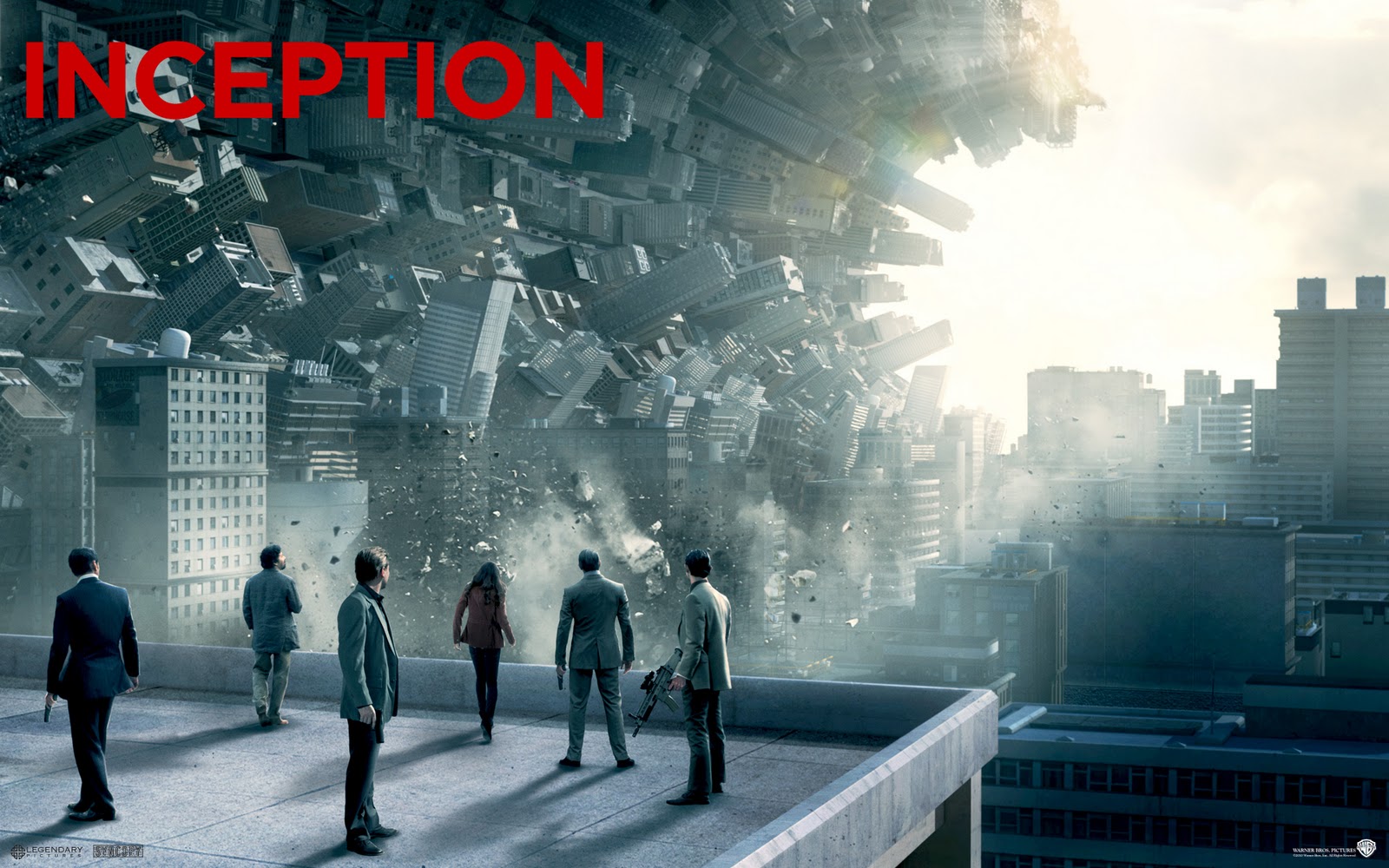
The movie, “Inception” shares the theme of reality with the examples of “Vanilla Sky” and “The Matrix.” In the film, “Inception,” the main character, Dom Cobb, played by Leonardo DiCaprio, is a thief with the rare ability to enter people’s dreams and steal their secrets via an architect. The architect is responsible for building the world of the dreamer, convincing them their surroundings are real. Since Cobb continuously uses his skill for corporate espionage, he becomes a fugitive. Seeing his abilities, Mr. Saito offers Cobb a challenging job of planting thoughts/information into a subject’s dreams without them knowing which is a process called, inception. In return for this job, Cobb would get to go back to reality peacefully without being searched for by the law. In the film, the most difficult thing to keep up with is: what is a dream? what is reality? who is inside who’s dream? These questions are usually answered by Cobb’s totem, a spinning top. If it was spinning, he was in a dream but if it fell, he was in reality. Yet, in the final scene, the spinner begins to lose its balance as Cobb went outside to play with his children. However, the film ends before the audience sees if it fell or no, leaving the audience wondering if Cobb ever returned to reality. As a positive viewer, one can assume that Cobb achieved his mission and got compensated with finally being able to go back to being with his children (reality). Yet, Cobb could’ve found his kids in the dreams and stayed there. One will never know.
Inception Ending: Cobb goes back to his family
Connection
As stated before, my example of the movie, “Inception” connects with the reading because of its theme of reality. The film shares the same components that the reading explains that other movies like “Vanilla Sky” has. For example, the fact that there are two worlds in both films: a reality and a false life (dream or illusion). Both characters must make decide if to stay in the false life or return to reality. Yet, Klosterman argues that the false world is the most pleasant place to stay at because it is built based on what the characters most desire. For instance, in “Vanilla Sky” when the character played by Tom Cruise lives in this lucid dream (false world), he experiences a life with his loved one but things get complicated similar to “Inception.” Because of these complications, the characters are interrupted by a greater power which brings them or asks them to go back to their real lives. Yet, in the film “Inception” one keeps wondering if the main character truly went back to reality while in “Vanilla Sky” one wonders how much of the film was reality. In other words, ending of “Inception” isn’t clear if it’s reality whereas “Vanilla Sky” doesn’t have a clear track of what is reality and not throughout the film but the ending is real. Overall, the movies have different plots but they share the same question of “What is reality?” and “Did the characters achieve the best choice by going to their perception of reality?” Like Klosterman states, these films do a good job at questioning reality instead of answering what reality is.
In the article “Space, Time, and DVR mechanics,” Klosterman discusses the concept of watching events live versus watching recorded events. In the article, Klosterman examines the question of why these recorded events are less enjoyable than the live version. In the end, the author finds that it comes down to the fact that the viewer is in control. They can choose what parts to watch and what to skip in the recorded events. As a result, they often skip through the commercials and the less dramatic parts. On the other hand, viewers do not have this luxury when watching live. However, these commercials and less dramatic parts of the event often build the hype and emotional investment of the viewers, so that when it does get dramatic they are often on the edge of their seat. Whereas those who watch the recorded version often don’t get as excited for these parts because they know that they have already occured in real life.
Outside Example:
I have several examples that connect to my reading. One of my examples is the show South Park. I have watched this show on Philo and decided to subscribe so I would get every episode. The show started in 1997 and has a lot of episodes throughout its 26 seasons. My next example would have to do with live sports. I grew up a huge Cal fan (UC Berkeley) and every Saturday I would watch their football games. The stadium is 30 minutes from my house and I would go to most games in person, but also watch some from home.
Reading Connection:
After being subscribed to South Park for a while I started to have a ton of unwatched episodes. At one point I found that I had over 40 episodes still waiting to be watched. However, I ignored these past episodes and made the choice to watch the new episodes or the live episodes first. South park is the type of show where you can usually watch a random episode without needing context of the previous shows. My decision seems to align with what Klosterman discusses in the article. SImilarly, with the example of Cal football, I would sometimes not be able to watch the games due to a conflict with an activity or a sport that I had that day. I was adamant about always recording the game, so I could go back and watch it. But what I found is that I would never end up being able to watch it. I would often get bored and skip until the end. Just as Klosterman mentioned in the article, I think at the core I view this time as wasted time because of the fact I know it already happened. As a result, I lose my patience and often skip it and check the final score.
In this article, the author discusses the divide between successful movies and interesting movies. He claims that movies have become less thought provoking and have skewed more toward efficiency, because this will bring in more money. In the past, films would validate social evolution and introduced a vision for the future. However, modern reality has become less concrete and many of the situations and characters that were prevalent in older movies are no longer applicable to modern film.The author’s other main compliant was the lack of an audiences concern for the more introspective concepts introduced by films such as What is reality? He claims the shift in the contrast between modern and older films is due to the fact that film present an object reality, but situational reality is often more complex so audiences feel a disconnect between them and the story being told to them.
Example
While reading this article, I was reminded of the movie Inception (2010). In Inception, a team of 4 (including Leonardo DiCapprio, Ellen Page, Joseph Gordon-Levitt, and Tom Hardy) have the ability to enter people’s memories and use this skill to steal information. In the beginning, Leonardo DiCapprio recruits Ellen Page to join their team and teaches her how to create a new reality within a person’s dreams. However, the main concern through out the movie was the risk of becoming trapped within the subconscious and losing their grip on reality. DiCapprio’s character had done this before with his wife and it led to her losing her understanding of reality. The end of the move leaves us with an ambiguous answer as to whether he is in reality or is once again stuck in his subconscious.
Connection
The article and Inception are similar because the author is asking the same question as the movie, What is reality? The article discusses meaningful movies and how objective questions like these are what make movies truely interesting. One of the biggest questions within Inception is whether or not the main characters will be able to make it back to reality, and if they are actually in reality or if DiCapprio has once again been trapped in his mind. Inception draws on a lot of the principles that the author claims are no longer present in modern films.





 Comm 2302 Spring 20