The excerpt starts by describing what a shot in a film is and then explains the different types of shots that can be seen in movies such as close-ups, longshots, two-shot, medium shots. The reading also states many movies where these different shots can be seen to make it easier for the viewer to understand what each shot looks like in a movie. It also mentions some tools such as zoom and freeze that are used in movies and explains why filmmakers might prefer that over other shots or tools in a particular situation. The other main part of this excerpt talks about sequence which is a group of shots that make up a segment of the film. There are many different types of sequences such as linear sequence, associative sequence, and montage sequence. To change from shot to shot, filmmakers might use cuts or transitions depending on what they find would be best given the situation.
Outside Example
Reading this made me remember about the movie by Quentin Tarantino “Once Upon a Time in Hollywood”. In this movie we meet Rick, a washed-out actor and Cliff, his stunt double who are trying to recapture fame and success in a new movie era. We see their lives on the job and at home and how they have very different lives due their salaries. As the movie progresses, we find that Cliff meets a hippie girl and she later takes him to meet her “family” which was a group of hippies formed by Charles Manson. At the end of the movie we see this same group of hippies going to a neighborhood in Beverly Hills where Rick and Cliff were hanging out. The hippies break into the house trying to kill anyone in the house, but it backfires and they get brutally killed. This was a twist by Tarantino on the actual event that unfolded, where a group of “kids” were sent by Charles Manson to kill famous actors and disguise it as a racial attack to create a war between races.
Reading Connection
The excerpt reminded me of this movie because in the movie we see behind the scenes of movies in Hollywood because we follow around two people that work in the field. We see how Rick and Cliff prepare for movies and scenes. We also see their interactions with other cast members while filming and off screen. The movie shows the audience a different point of view and the problems actors face when making scenes. In one scene we see Rick forget lines and has to start the shot over. We also see how he tries to find the best way to say a line to make the movie look realistic and make the audience believe they are in the movie.
When producing media, taking “unconnected anecdotes, ideas or bits of tape” and shaping them into a coherent storyline is a difficult job. Using movies as an example, the chronology or order in which a story plays out can affect the audience in multiple ways. For example, placing the end scene at the beginning of a movie or throwing the viewer into the story en medias res functions to create narrative suspense, keeping the viewer engaged and interested.
Outside Example:
When reading the text, one example I thought of was the movie “Girl on the Train”. “Girl on the Train” is a mystery thriller drama based on the book of the same name written by Paula Hawkins. The movie centers around Rachel Watson, an alcoholic, who rides the train aimlessly since losing her husband and job. She thinks obsessively about her ex-husband (Tom) and his neighbors, Scott and Megan Hipwell who she idolizes. Rachel one day observes something awful occurring in the Hipwell home, forcing her to begin her own investigation after the police refuse to take her seriously on account of her alcoholism and untrustworthy memory. She learns that her life and the lives of the Hipwells and Tom are much more connected than she ever thought possible.
Connection to Reading:
This example connects to the reading as it relates to how manipulating the chronology of a story affects the reader. “Girl on the Train” begins en medias res. As the viewer, we are first introduced to Rachel in the aftermath of her divorce and unemployment. By starting the movie in the middle of the story, the film producers create suspense which drives the movie. We don’t know anything about her past but – as she uncovers her ex-husband’s lies- we learn about her as she learns about herself, keeping the audience engaged.
In the podcast, “View from the Other Half” by Griffin Hansbury, the speaker describes his and his friends’ experiences as transgender individuals. He explains that they were born and raised as females but grew up to identify as males. Their transition was not easy. In order to feel a sense of belonging in society and self-acceptance, they felt the need to take testosterone and go through dangerous surgeries. Although they had to make changes in their bodies, they were happy to look like how they identified. Yet, they revealed that they faced a serious challenge when trying to navigate the dating life. The transgender men at the podcast described that for a long time they were considered as lesbians. This was not the case as they were men. Yet, they did not take it as a huge offense and even continued their dating experience. One of the transgender men at the podcast, Ray, explained that he did not know how to ‘pick up’ women after his transition. Later, they explain their encounter with a group of women as they headed to Atlantic City. The girls asked them if they wanted to go skinny dipping and as excited as the guys were, they denied the offer. Why? Because they knew that they would have to explain why their bodies are not 100% anatomically male. For the group of transgender guys, this was a harsh reality. Although they admit their lives have been difficult throughout their transition, each man has had different experiences. While Ray has experienced trouble, Ethan’s confidence has led him to hook up with almost all the women he has pursued. However, there was one exception to this story. Nate always knew that he was a male but his discovery was that he was attracted to other men. He struggles constantly in finding someone who accepts his transition from women to man and being gay. This podcast brought light into the struggles of trans individuals.
Outside Example
As I was hearing the podcast, I was reminded of a very realistic and modern show called “Good Trouble.” The show is a spin-off of another show called “Fosters.” In “Good Trouble,” the two main characters, sisters Callie and Mariana, move to L.A. to begin their adult lives. Upon their arrival, Callie begins to have a romance with one of her neighbors, Gael. Their relationship was very casual but Callie seemed shocked and almost offended when she found out that Gael was bisexual. Gael explained that he did not think that he needed to tell her about his sexual orientation because it should not matter. Eventually, Callie accepted it and they grew to have a serious relationship that did not last very long. Although their relationship didn’t last, they remained really good friends to the extent that Callie helped Gael’s sister, Jazmin, in a complicated legal matter. Jazmin was born and raised as Alejandro, a man who grew to serve in the army. After coming back from the army, she decided to perform surgical procedures to become a woman. Despite her female looks and the L.A. transgender protection laws, she faced discrimination everywhere she went. She was assaulted by a cop and fired from her job for having an inaccurate ID. Throughout the show, Jazmin attempted to change her ID and all her legal documents but she failed because the process was very tedious and expensive. On top of all this, her family did not speak to her after her transition. Hence, Callie seeks help from one of her lawyer friends who explains to Jazmin that she can file a lawsuit against the cop and her former employer but that she would probably spend a lot of money and would unfortunately, lose.
Connection
The audio and the series are very similar because they display the hardships of the lives of transgender individuals. The series goes further to illustrate the lives of all LGBTQ+ members. Unlike many other shows who illustrate the LGBTQ+ community as “gay best friends” or “sexy lesbians,” both the podcast and my example do a good job at detailing the reality. There are many members of the LGBTQ+ community who do not have the same economic, social or emotional support as others. In both the podcast and “Good Trouble,” the audience is able to see average people who went through a physical change and are excited for their lives only to be discriminated by society. Although the podcast emphasized more on the challenges of dating than on legal matters, both sources brought awareness in how difficult the lives of transgender individuals are. Attempting to showcase their true identity comes with many strings attached like denial from family, friends and society. As heard in both my example and the podcast, the transgender individuals become afraid of being denied by others so they avoid social interaction. Transgender individuals are forced to always explain why their names and/or bodies do not match their said identity or appearance. It must be very difficult to introduce yourself by saying “I’m Jazmin but I was originally Alejandro” or “by the way, I used to be a woman.” It definitely is a challenge that should not exist. Transgender individuals should not have to explain their bodies or names as if they were some sort of unknown species. They are human. They have rights.
The comic talks about how you piece things together when writing a story. It starts out by showing some of the stories that a flight attendant has. It talks about taking a bunch of unconnected anecdotes and forming them together is hard. Narrative suspense is when you put things in chronological order, and it is the default. But sometimes you want to put an anecdote at the beginning to capture attention. It also discussed how scenes can simply fade out into other scenes. For a scene to work, they say that you need to create a vivid image in the listener’s imagination. You should use an active voice, because it helps to create a scene and is easier to follow. The comic strip also talked about the importance of collaborating while writing. It also discussed how radio shows and podcasts can be seen as writing, just in a different form. Additionally, sometimes you need to signpost things, or basically say what’s important, so that the listener can follow along without being confused.
Outside Example:
When I read this, I thought of a lot of indie films that have really bad transitions. You don’t really notice when a film has good transitions, because it flows naturally. However, I have noticed that there are plenty of indie films with really bad transitions that just go from one scene to another. For example, I watched a film called Flower, and it had really bad transitions and absolutely no flow. I couldn’t find a video online, but it would basically cut from scene to scene with no transition. For example, one time they were driving to Mexico, and then the next scene the girl was making out with her step-brother.
Reading Connection:
This connected to the reading, because it talked about the importance of scene transitions and one scene flowing into another. The indie film is obviously did not have very good film transitions. Because scene transitions are expensive, the indie film could have probably used another technique, such as using the narrative/chronological method. However indie films are good at being very descriptive, which makes you feel like you are playing a role in the movie. There is a great deal of vivid imagery throughout the film and in each individual scene.
The podcast discussed how difficult it is for trans men to find love on the other side. The difficulties of men trying to find women to date without the process ending as soon as they tell them they are trans is likely. They discuss both the scary and sucky parts of going through the transitional part as well as the exciting part. It is a complex journey, however the benefits seem to be worth the costs as portrayed through the numerous individuals circumstances. A big emphasis was placed on the ending trans people fear the most, which is disgust. In addition to their fears comes situations, such as skinny dipping when they are still transitioning because they are missing out on “defining moments.” The moment of revelation leading to a severed relationship is common. Many described transitioning as a romantic experience once they enter the unknown on the search of simplicity. It is also stated how Those who do not undergo these circumstances or desires of change sometimes take for granted.
Outside Example: While listening to the podcast I was immediately comparing the statements to those of jazz in the TLC show series. The show documents the life of a young boy transforming into a girl at a young age and the trials and tribulations that are accompanied with that process. I watched this show often for pure desire of perspective. It is wise to hear their process and feelings while undergoing change in their pursuit of happiness and new identities.
Connection: Similar to the podcast, the show addresses the discomfort of being transgender. For example, their biggest fears in public and in interpersonal relationships, especially romantic relationships. In the podcast both some individuals were single, some dating, others married. Every individual experiences different levels of difficulties in the dating realm, however they all generally have the same fears such as exclusion and discrimination. These are expressed by jazz as a young transgender a different situation with similar emotions.
Reading Summary Jessie describes two completely different scenarios that both involve loops. The first is between two comedians, Kristen and Kurt. The first time they dance and sing, respectively, the audience laughs and seems to enjoy it. As they continue to repeat the performance however, the audience grows more uninterested until they stop laughing completely. After a while of the same performance loop, the audience starts to laugh again, most likely due to the absurdity of the situation and because of how they felt if they had control of their laughter, it would become funny again. The second scenario she describes is about Christine’s mom, who suffers from Transient Global Amnesia. This condition causes sudden memory loss and prevents the creation of new memories for up to 24 hours. During that time, she would continuously recall past conversations in her head, effectively playing them on repeat and being a hostage to her mind.
Outside Example Loops are instrumental to the construction of beats in DJing and certain forms of beatboxing. You start with a few rhythms and repeat them to form your base. You then build on that base in order to form more complex rhythms and songs. A great example of this sort of rhythm building is in the Grand Beatbox LOOPSTATION Battle semifinal between MB14 and SARO. I know admittedly little of beatboxing, but this was a very interesting and entertaining competition. https://www.youtube.com/watch?v=-U0AFQbfv88
Reading Connection Loops can appear in many shapes and forms. Jessie talks about loops in performances and in neurological illnesses. For the audience, that being the mother and the actual audience during the performance, our brains can make us feel captive to the situations we find ourselves in. Though looping in the construction of beats in DJing and beatboxing is similar because of how an idea repeats itself, it is different in the sense that the person constructing the beat has total control over it. These aspects of looping show the amount of control, or lack thereof, that we have over our minds.
Summary: This article is unique in the way it is giving its information through a comic book style. It starts off with an anecdote about a flight attendant and her story and goes through the steps it took to mold her anecdotes into a real story. As the article goes on, we learn that they are basically putting together storytellers’ perspectives on structure. It then talks about chronological order for narratives and the role of the hook. It discusses the importance of “taste”. It talks about scenes as building blocks and how to develop one with visual imagery. It then shows how sign posting works on radio so that the listener can follow the flow of the story. Some use reflection to help guide the listener to the moral of the story while some say that is up to the listener and would never interfere with this idea of resolution and how that makes the listener feel. It compares structure to arranging flowers to show how improvisation can be a technique. It then talks about the difficulties they go through when doing a story from imagining all the different paths to take to the doubt and focus it takes. The German forest metaphor describes getting lost to all the choices and then discusses why creative work is so tasking but why its “transformative”.
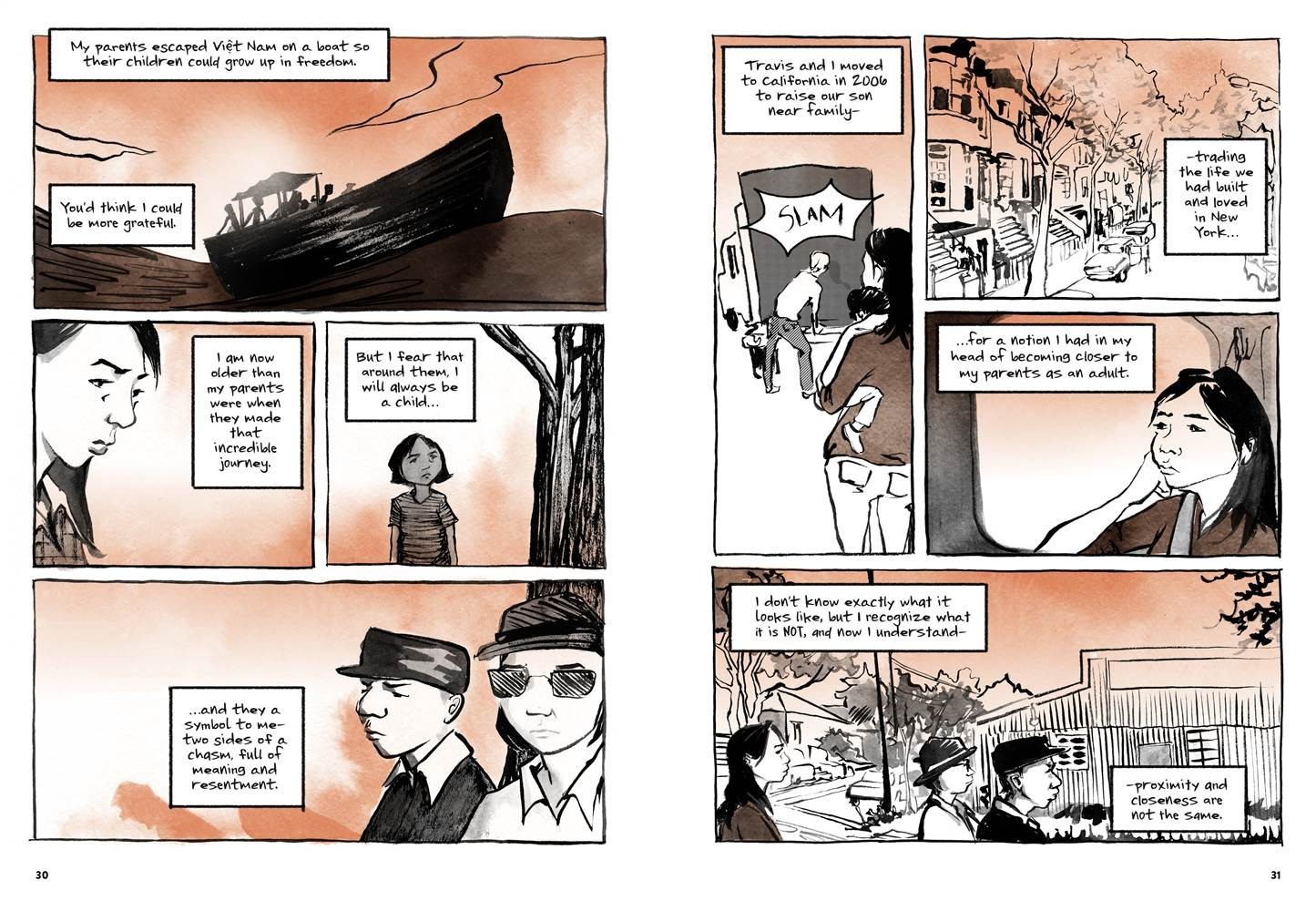
Personal Example: This article reminds me of a graphic memoir I read for a class called “The Best We Could Do” by Thi Bui. It is structured the same comic book way and gives the story of her life. The book is about how immigration made her feel stuck in two places with her family’s past and tradition as well as moving on for a better future. In class we talked a lot about how she structured it to both give visual imagery and the moral of the story just like the article discussed.
Reading Connection: The novel takes little anecdotes from her life and combines them with the visual aspect as well as insight into the characters thoughts to emphasize how it shaped her. In the example of the flight attendant from the article it says that the story was not the 9/11 anecdotes but how she found meaning in her job. This made me think of the main character because it wasn’t all the stories about her fighting with her mom over traditions or the little moments where she found peace that made her feel stuck in the two places, it was the journey of immigration and going through school to support her new family that did it. The author did this through structuring the scenes chronologically to emphasize on how they built up to the end where it shows how she got to that mindset with some reflection here and there to help put the reader in her shoes and guide them to feel sympathy for her.
This podcast is about a group of transexual men who were born female and raised as girls but made the transition to male. Many of which are either in relationships, married, or are dating. One friend talked about learning how to socialize as a man as they were never taught how to approach women or give hints that they were interested. It can be awkward getting to know the opposite gender when they don’t know about the person being transgender as at any point you can be put back in to reality very quickly. One friend explains that some days are harder than others as you can forget that although you live as a man and see yourself as a man, it can be disappointing and sad when you have to explain yourself to significant others. It can be harder dating as a male than a female, because as a girl you don’t have to think about calling first or planning dates usually, but as a man you have to get used to these new codes of behavior. Sex life is a very popular question for many transgender people. A interviewee on the podcast described those questions as feeling like a science experiment. She explained missing the simplicity of having an ordinary sex life, but not necessarily missing being the opposite gender.
Outside Example
As a fan of Keeping Up with the Kardashians, listening to this podcast reminded me of Caitlyn Jenner. In an interview with Diane Sawyer one year after her transition, Sawyer asked Caitlyn the basic transgender questions. For example, “do you miss being bruce?”, or “do you ever have doubt that you did the right thing?”. Questions like these can make transgender people feel like they are a science experiment or makes them feel weird or out of place; like they are not normal. Caitlyn Jenner, being as famous as she is, does not seem to put off questions about her sexuality as she has learned how to be in the spotlight after many years being on television.
Reading Connection
Getting asked questions about your daily life or the way you choose to live your life can be very intimidating, especially when you feel as though your life is significantly different from the the ones around you, and asking those questions only divides and enhances those differences more. Caitlin Jenner, after being in the public eye for so long was used to the scrutiny and judgment that comes from being famous, so her transition was not that big of a change in public outlook as it would be for many normal trans people who choose to live quieter lives. Although many people do genuinely want to learn about how trans men and women live, it is up to the person to decide how much to how little they want to reveal about their personal lives. It may do people good, as well, to do their own research before straight up asking people they may know as transexual questions those individuals may not necessarily be comfortable answering.

 Comm 2302 Spring 20