There is no disputing that sex plays a crucial role in marketing and advertising. Motivational analysts seek to discover the potency of sex symbols in the market and what drives the need for exploitation of one’s body to sell goods. The presence of sex symbols in the market have followed certain trends throughout history. A prevalent theme when marketing towards females in the 1950’s was the “get-your-man” promises. This was popular with perfume companies, for they promised one spritz of their perfume and you could get any man you desire. However, this trend died off due to the modern woman’s ability to no longer becoming bewitched by empty promises. Consumers became smarter and more opinionated so the market had to shift with them as so. Marketers began focusing on deeper sexual yearnings that products may symbolize. Analysts identified the need for sexual reassurance in consumers. Such as women need to be assured of their femininity and men of their masculinity in the products they purchase. Marketers began focusing on the indirect meanings of their products in order to identify their target audience.
Outside Example
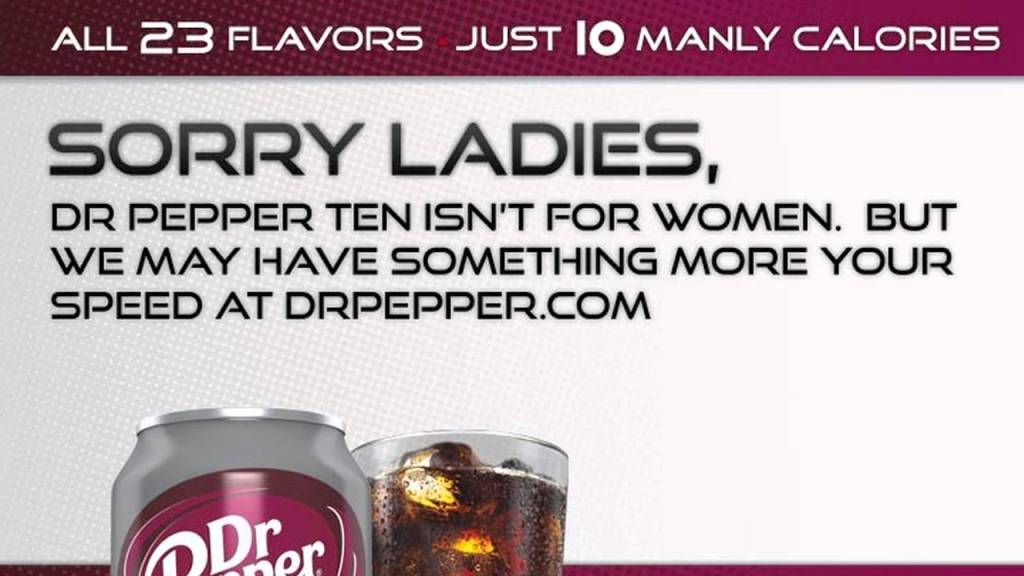
This reading reminded me of Dr. Pepper’s “Not for Women” campaign. Around 2011, Dr. Pepper targeted an audience of men who wanted a lighter soda but didn’t want to infringe on their masculinity. What was created was a 10 calorie soda that had the label “Sorry ladies, Dr. Pepper 10 isn’t for women.” The product was even packaged as a masculine symbol with gunmetal grey and a bullet looking shape. However, this ad’s exclusion of another gender could be deemed sexist. Many complaints were raised that you can target the male audience without being offensive women.
Reading Connection
This reading states that male consumers desire sexual reassurance. Dr. Pepper played on this aspect of their consumer behavior by producing a diet soda that didn’t infringe on the male’s masculinity. Dr. Pepper male consumers could seek lighter calories in their drink without feeling the slightest bit feminine. This ad campaign is a great example of how marketers can identify the indirect meanings of products. Diet usually equates to feminine, so a diet soda marked “not for women” does well in soothing the masculine ego.
The article emphasizes on how companies have and still use sex and gender as a marketing strategy. The article uses several examples such as a simple perfume to illustrate the dissatisfaction felt by men and women as they realize that the quality of their products are extremely stereotypical of their sex. However, the article also discusses the evolution of sex as a strategy by saying that it has changed to attempt a fair and unbiased portrayal of their audience. For example, the article explains how car companies have changed some of their old selling tactics from “mistress to wife”. They made a switch from trying to sell convertibles using women’s sexuality and the “mistress” adventure to selling a sedan car as “the wife” for its reliability and stability. The article further explains that the change has been seen in multiple other companies such as lingerie, female products and also male products because both men and women complained about the high and unrealistic expectations made by ads. Although, there has been a change, the reading says that there are still ads that enforce this unrealistic and stereotypical marketing strategy in their ads.
Outside Example
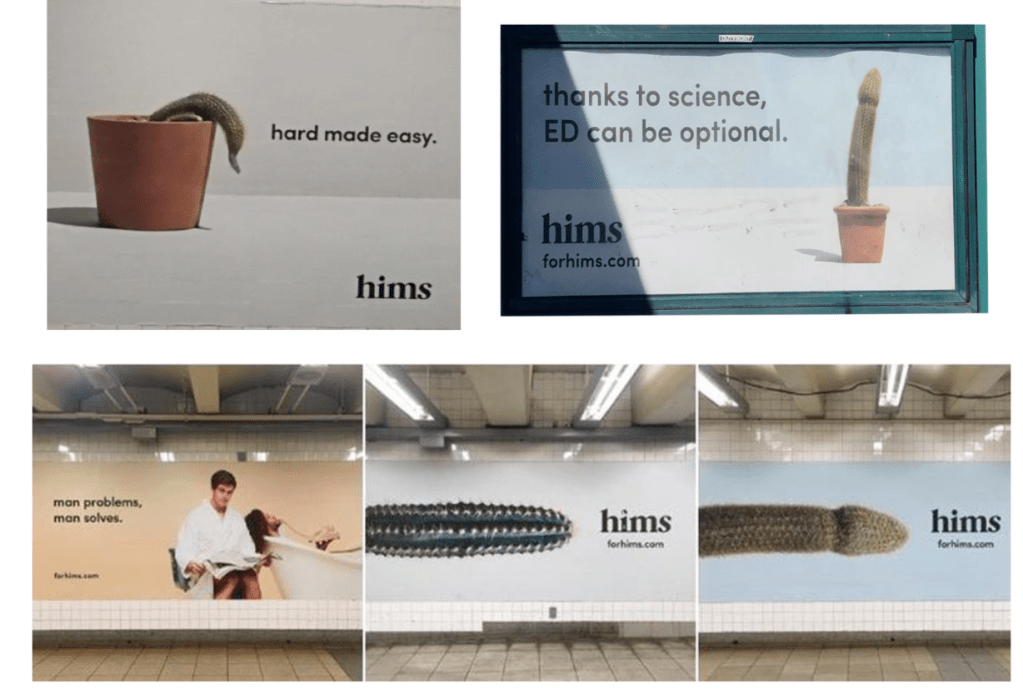
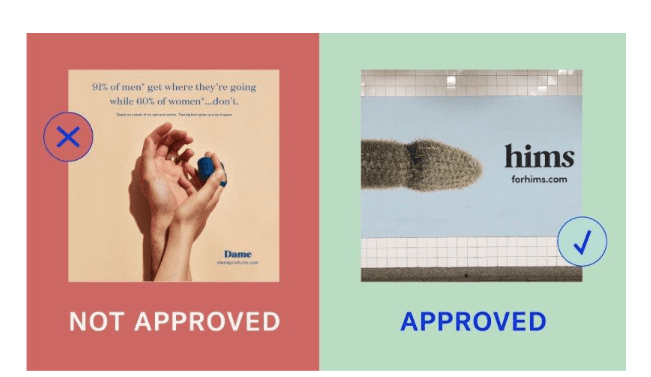
The reading made me think of one of my favorite shows, “The Bold Type” which is about a global women’s magazine which fights against stereotypical images of women and sometimes men and other genders too. In the last episode, one of the main topics was the fight for advertising a company that sells products for women’s pleasure. The seemingly appropriate ads of the company were not allowed to be posted on the walls of the subway because the Metropolitan Transportation Authority (MTA) saw them as inappropriate. Yet, the women of the magazine continued fighting for the right to put the ads because the MTA permitted the use of erectile dysfunction ads which illustrated the image of a corn shaped as a penis to be in the walls of the subway but not the women’s pleasure one which was clearly appropriate. Since the show typically references to real-life discrimination/sexism conflicts, I decided to look into the situation of the women’s pleasure ads and found out that it was a real issue. Not so long ago, in early 2019, the subway walls in New York City were plastered with ads featuring cactuses standing and slumping to advertise erectile dysfunction drugs from the company, Hims. After seeing the ads, the Dame company which is a company featuring products for women’s pleasure requested permission to add some of their ads to the subway walls as well. Yet, the decision of the Metropolitan Transportation Authority to not allow the ads to be posted was not what was expected. Therefore, the Dame products decided to sue the MTA for stereotyping sexual pleasure as an activity just allowed for men. The NYTimes article that reported the situation described that women’s sexual wellness represents a large and growing market but companies trying to address it constantly face barriers that businesses aimed at the sexual wellness of men, do not.
New York Times article on the lawsuit between Dame Company and MTA. Hims ads posted all over New York City subways. Comparison between the Dame women’s ad and Hims ads.
Connection
The connection between the fight for women’s sexual wellness ads and the reading is pretty obvious. The reading talks about the use of stereotypical sexual interests to advertise products. In the reading, there is an example of the difference of the scent, strength and the ads of a perfume between men and women. In my example, there wasn’t even a chance for the ad featuring women’s pleasure to be posted because it was seen as “unnecessary” and “inappropriate”. This portrayal of sexual wellness and pleasure for women as being unnecessary is absurd and started because of the idea that women don’t pursue sexual satisfaction and that for them sex isn’t as important as it is for men because of their “pureness” and “delicacy.” All these stereotypes have been altered by our culture which tends to categorize women who are interested in sex as “slutty.” To add on, the reading exemplifies this by describing how men’s advertisements have used men’s sexual desires of “getting a hot woman” to advertise their products, such as cars, that have nothing to do with sexuality. Hence, when it comes to advertising for men’s sexual pleasure, it is automatically accepted by society whereas, women’s pleasure isn’t because apparently “women could never want that.” Yet, women have been fighting for the right to promote sexual wellness not only for pleasure but also to improve sexual health. This fight and change in advertising sexual health is very similar to how the reading stated that women fought for ads to promote respect towards their role as partners and to stop illustrating them as mistresses.
This week’s reading centers on how advertisers create effective and persuasive commercial texts. Textuality is the specific mode of making advertisements on the basis of specific signification systems built into the products marketed. The signification systems are constructed based on a signifier’s connotations, creating connotative chains from which a mythic subtext can be gleaned. One example of creating textuality is mythologizing a product. Mythologizing a product involves embedding a specific mythic code into the make-up of the text.
Outside Example:
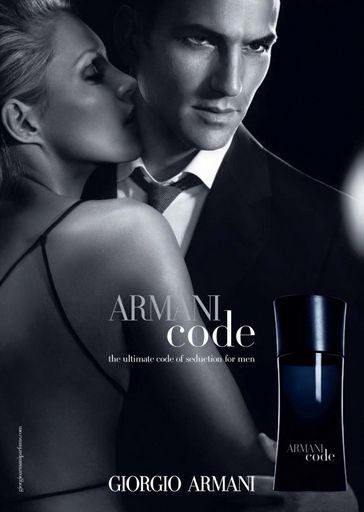
One example I thought of while reading the chapter is Giorgio Armani’s ad for the new perfume “Code”. The producers of the ad have labelled it the “ultimate code of seduction for men”, placing the slogan against a predominantly black and white image of a handsome man and attractive woman embracing.
Connection to Reading:
This ad is a clear example of mythologization – embedding a specific code into the product perhaps with the intention of appealing to a particular audience. In this case, the said audience is young professional men earning at the higher end of the pay scale (Armani is not cheap). Given his good looks and crisp suit coupled with his well-lit and central placement, the model pictured above is connoted as an ideal of male beauty and male professionals . The scantily-clad and attractive woman pictured wrapping her arms around him connotes seduction and irresistibility. The contrast in the color-scheme (black and white) creates an intensity furthered by the sharpness features and powerful gaze of the man, suggesting confidence and dominance. Based on these connotations, a mythic code is created: Wearing Giorgio Armani’s new “Code” perfume makes you more attractive, confident and irresistible to women.
The excerpt begins with an example of an ad from sparkling wine maker Marilyn Peach. In this example the reader is guided through a connotative chain in which a interpretation of the meaning of the ad is derived.
More depth is then given to the explanation of the example were the signification system of this ad and others is explained.
Another aspect behind the ad that is explained is the mythologizing of the product. Here it is explained that a product can have connotative meaning in the add by making allusions to myths that already carry deep meaning and expectations.
The excerpt goes on to explain that the layout and design can have importance to the meaning through highly suggestive subtext. Of great importance is also a products ambiguity because this allow for many interpretations of the subtext that can reach as many people as possible.
Outside Example
One example I was reminded of was a YouTube video called YouTube Rewind 2018, but its actually good. In this video a compilation of memes and clips of real world events is used to give somewhat of an outline of the year 2018 for YouTube. In the video the events that are shown are ones that were popular or had great significance to the year. While some of the events if not most of them will not be known by every viewer of the video, because there are so many parts in it almost everyone will see something that will remind them of 2018.
Reading Connection
In the excerpt mythologizing a product and connotative chains are explained in examples. In my example the memes are that are throughout the video are packed full of meanings and allusions to past events and ideas of various significance. These meanings and allusions allow people to glean a great amount of information from the connotative meanings of the memes just like the ad layout and designs of the products from the excerpt.
Summary: The article opens with the idea of the content analysis process to interpret meaning in a text. It shows this through the example of the peach wine ad and analyze all the components of the ad to show the biblical allusion to show the idea of temptation to convey the wine’s temptation. It then talks about textuality and how it forms the base of advertising by signification systems. It gives the examples jingles, characters, and celebrities to see how these signification systems work to advertise the product. The article then discusses mythologization and shows the concept through the fancy cologne example. It tells us the importance of visual texts to make the chain of connotations. The article then discusses some of the techniques used to create suggestive texts. Layout, design, and ambiguity are examples of techniques that help guide the connotation of the ad so that it can become persuasive, while giving enough room for the interpreter to give their own take and generate interest and appeal.
Personal Example: When reading about the different technique’s advertisers use to make an ad successful, it made me think about sports teams, specifically my favorite baseball team the Texas Rangers. Just like other sports teams, the rangers have the Mascot (Rangers Captain- a horse), team colors, and endorsements.
Reading Connection: On page 65, it says “the textuality generated by ads and commercials is an intrinsic feature of advertising”. It talks about the Rice krispies jingle and it made me think of Ron Washington’s famous saying, “That’s the way baseball go” and how that slogan represented the rangers for a while. Then it talked about creating characters like Tony the Tiger, which made me think of the Rangers Captain (horse mascot) that represents the team. The team itself has famous athletes with fans to endorse their own team, but also celebrities outside of the team help build the team, for example, one of the biggest all-time fans of the rangers, George W. Bush. A trend with the team and fans was the antlers and claw signs. They would make these signs after a good hit and it became a sign for the rangers. All these aspects are built into the brand of the Texas Rangers and are incorporated in advertising the team because they “enhance the product’s recognizability”.
Pop culture is constantly changing, and to study it we must have a method that allows for that frequent fluctuation. The semiotic method is one way we do this. We read signs in pop culture to better understand the meaning behind things. A sign could be something visual like a stop sign, or something you have to read more into to understand. The second part of this method is understanding connotations and denotations of these signs. The third is overdetermination, understanding that there can be multiple different meanings behind a sign. The last part is understanding the culture behind a sign, for example if there are myths about it.
OUTSIDE EXAMPLE
When reading this text, I immediately thought of The Bible. Being a Christian my entire life, I’ve been taught by conservative sunday school teachers that the Bible is to be read literally and has no errors. Being in a Old Testament class this semester has taught me that much of the Bible is symbolic, and must be read in context to its time. Isaiah 53:7 says, “He was oppressed, and he was afflicted, yet he opened not his mouth: he is brought as a lamb to the slaughter, and as a sheep before her shearers is dumb, so he openeth not his mouth.” We see here the Jesus is referred to as a lamb, and this is done numerous times throughout biblical text. The Lamb is a sign.
CONNECTION
To call Jesus a lamb is extremely symbolic and stands for much more than just a literal lamb. In context, a lamb was a common animal, known for being weak in biblical times. It completely juxtaposes the “strong, great” connotations that people have about Jesus. But a “lamb being brought to slaughter” symbolizes the crucifiction of Christ later in the Bible, saying He went before the people for their sins. Without analyzing this sign, this symbol would make no sense.
The articles focus on how advertises have used sexual tones in their advertisements to either bring in a particular target market or appeal to men/women through their carnal desires. Examples would be how advertises promised to make women more desirable if they purchased the product or how men would look more masculine if they had this product. The articles also discussed why products that are used or consume orally usually perform so well. Things like cigarettes and gum provide a natural comfort in the same way a child finds comfort in breastfeeding, showing how products can appeal to our more basic or infantile forms of stress relief.
Outside Example:
This advertisement by 5 gum depicts a young man in boxers who seems to be apart of an experiment or test. He proceeds to lie down in a large platform filled with a sea of small metal balls. As the the man in the room above turns a knob, powerful speakers begin blasting waves of low frequency sounds that become stronger and stronger until the young man is brought from the balls covering him, moving him up and down to the rhythm of the bass that is blasting all around him.
Connection:
This advertisement is very sensual as it incorporates many of our senses.The balls look hard yet support the young man as he is thrown up and down by the bass. The young man in the advertisement is also only in his boxers which adds a certain amount of vulnerability to the character, but at the same time he is confident and seems excited with the experience is about to have. The advertisements are also for gum, one of the products that are so popular due to the comfort they seem to inherently offer. This fact, along with the sensual depiction between the scarcely dressed man and his rhythmic movement with bass and the balls around him, make the advertisement seem sexually charged in some aspects.
Semiotics refers to the study of signs, which are anything that carries meaning. Words, gestures, names, objects, and just about anything else can be signs as long as they convey a message. In order to understand signs, we must understand a few things. First, it is necessary to recognize that different signs have different meanings. Otherwise it would be impossible to analyze the nature of signs. Secondly, we must understand the denotation and connotation of a sign. The denotation is the substance that the sign directly shows. It is the literal meaning of the sign. The connotation is the political or cultural significance of a sign. In order to learn the true connotation of a sign, we must use abduction. This means arriving at a conclusion by following the most plausible explanation. Though there are rarely any certainties when it comes to realizing the nature of a sign, we can get close. Sometimes there are multiple explanations for a sign, in which case we say they are overdetermined.
Outside Example
I immediately thought of the game Phoenix Wright: Ace Attorney when reading this chapter. Phoenix tries to prove his clients are innocent by leading investigations and conducting courtroom trials.
Reading Connection
As a lawyer, Phoenix’s job is to analyze and interpret signs in order to win his client’s freedom. In order to do this, he must follow the semiotic method: he must differentiate between important signs, understand both their denotation and connotation, and finally, explain his reasoning through abduction. This is represented in gameplay through investigation scenes and courtroom scenes in which Phoenix’ reasoning and logic are put to the test.
The Built in Sexual Overtone describes the evolution in using sex as a marketing tactic. Simple ‘Get Your Man’ advertisements led to disappointment for women when the perfume bottle or the cosmetic product did not, in fact, lead to a man. Women wanted to be respected by men as partners, which was more tricky to elude to in advertisements. However, sex continued to be used as an eye-stopper, becoming more bold as viewers became more accustomed to it. Merchandising analysts looked into ways marketers could use our deeper sexual yearnings to sell products. Dr. Dichter came up with “Mistress versus Wife” for Chrysler Corporation. He theorized that men view convertibles as a mistress because it represents youth, romance, and adventure. Men usually bought more sedans because they were more reliable, so to speak “the wife”. After this study, the hardtop was created and it was very successful because it merged both the wife and the mistress. Another tactic was reassurance. Women were taking on more male roles and had to fight hard to be seen as equals in the workplace, at the expense of being “tender.” Apparently, this is an inherent feminine trait. Marketing for lingerie and things of that nature began to try to reassure women of their femininity and cut male approval out of their ads. Men also needed this same reassurance in their masculinity, with women wearing trousers and working jobs. For men, this is accomplished through magazines that inflate the male ego and products like cigars, that assert male dominance. This article then takes a turn and focuses on Freud’s theory of oral fixation and how merchandising analysts use this primary impulse to advertise for milk and other foods.
Personal Example:
This article immediately reminded me of things that are marketed for women or men that are generally universal, like razors. Men’s razors will work for women and women’s razors will work for men. However, often, women’s razors are priced higher.
Connection to reading:
After I realized that women have the capacity to use men’s razors, I wondered what the purpose was of selling two different razors. However, this marketing tactic would make sense to reassure men and women of their masculinity or femininity, respectively. Women’s advertisements for razors seem more soft and use less harsh, more stylized font. Men’s advertisements use dark colors like blue and black and try to appear more industrial. However, there has been a push by the feminist community for a change in this type of advertisement.
This reading discusses semiotics and the meaning behind certain signs and symbols. Semiotics are a major part of the commercial world today. Over time, through constant and repetitive branding, connections become stuck in our mind as we associate certain brands with a deeper meaning. The article also elaborates on how symbols and signs represent so much more than their literal denotation. The reading contrasts denotation, the primary surface level meaning, with the connotation or what the symbol suggests in the form of a deeper meaning. Overall, the article also illustrates the different lenses through which these signs can be looked at as well as the four elemental principles of semiotics. Lastly, the reading touches on the challenges of the semiotic method.
Outside Example:
My outside example is Los Pollos Hermanos, a chicken restaurant. This restaurant is part of the TV series “Breaking Bad” and the owner, “Gus Fring,” appears to run a stand up business as he takes pride in good customer service. It isn’t until later on in the show that viewers realize that the restaurant is a front and is actually a secret drug business. Fring uses the company to transport Meth all around the country and even abroad. Due to the extreme popularity of the show, this fictional TV restaurant is now an actual business in the real world.
Reading Connection:
I think that this Los Pollos Hermanos sign has a lot to do with semiotics. For starters, it directly relates to the conversation of denotation and connotation discussed in the text. In the case of this sign, the direct denotation may be that it represents a restaurant and is marketing the food that they have there. However, upon looking further one will find that there’s a deeper meaning and a reference to the underground drug business that this sign connotes. This deeper meaning isn’t universal to everyone as only those who have seen the show are aware of the suggestive meaning. This brings up one of the challenges of the semiotic method as one’s interpretation of a product is tied to who they are and their own, individual experiences. Overall, this sign serves to showcase semiotics and how there are many deeper meanings than what is denoted by symbols on a surface level.






 Comm 2302 Spring 20