Reading Summary:
This chapter talked about how groups often try to be “inclusive” while still maintaining a distinctive identity. The words “we,” “us,” and “you” have a great deal of rhetorical power. If a title of a news article says “you,” it is addressing you directly and is more personable. You are now part of the “us” group. Oftentimes, news articles “other” people, saying that “we” are threatened by “them” (the chapter was referring to the title, “Radical Muslims are out to destroy our way of living”). This is called “interpellation,” or when a person accepts that they are being addressed. Over time, through repetition, interpellation can send messages of who belongs and who does not. If media presents protagonists who are somehow “like us,” then they also create a world of Others who either oppose the protagonists or present alternatives to them. The chapter talks about how many cultures are often projected as “others” in the media. For example, if you don’t know any or spend any time with Native Americans, you might stereotype them as the media portrays them. However, if you have many Native American friends, you are less likely to generalize and think that all Native Americans act the way that the media portrays them. Othering is often used in films when mediamakers are trying to make the antagonist look as bad as possible. The antagonist often portrays people’s worst fears in order to ensure that the audience will not like the antagonist. This is especially common in horror movies. It is often hard to classify people into such broad groups as “role models” and “negative stereotypes.” A standard othering strategy is making events happen in the past. This already makes the event seem distant, and the people seem different from ourselves. It allows the narrative to be more straightforward than if it were taking place in the present-day. Some media texts display the “other” as someone who is almost perfect, so they must be liked. This is called the power fantasy. Exnomination is another othering strategy that literally means not naming. By not naming what makes someone different, you are not othering them because it is not notable enough to mention.
Reading Connection:
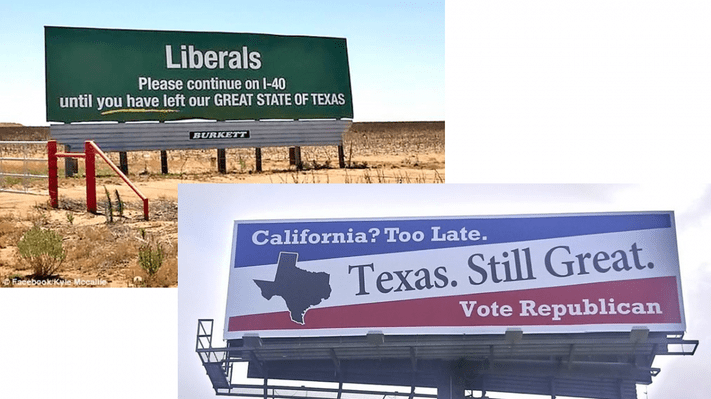
When reading about othering, I thought about some of the signs in Texas. These signs are “othering” the new people moving to Texas, most notably the Californians and liberals. The second sign is generalizing that all Texans vote Republican and that all Californians are liberals. Both signs generalize that native Texans are more likely to vote Republican and want liberals to get out of the state. This gives liberals and new people moving into the state the clear indication that they are seen as the “others” and are not the norm.
Connection to Reading:
The signs connect to the reading, as the reading talked about how the media can show people who is considered part of the norm and who is “othered.” Through repetition of the stereotype that Texans are usually more conservative and other states, especially Californians, are more liberal, people start to believe it as true. For example, The Dallas Morning News reported that native Texans were more likely to vote for Beto in the 2016 midterms and transplants voted for Ted Cruz (this was based on a CNN exit poll). If you know a lot of liberal Texans or conservative Californians, this might not be surprising. However, because the stereotype of conservative Texans and liberal Californians is repeated so many times, it is something that many people believe is true.
 Comm 2302 Spring 20
check plus
LikeLike